
Are you in the market to buy a new oven in 2026? With so many options available on the market, how do you know which one is the right choice for your kitchen? We’ve created a simple guide which breaks down the wide variety of options available so that you can make the right selection both for your kitchen layout and your available budget.
Whilst the purpose of this oven buying guide isn’t to specifically highlight brands or models exactly, some may be included to give you a prime example of each type of range or oven listed.
In this guide, we will cover the difference between ranges and ovens, whilst assessing the production choices of each style. This article will also cover the width and capacity that is available on the market currently, as well as the fuel options that comprise the market for both stoves and ovens. Finally, we will also give you an overview of the latest gadget to arrive in kitchens: smart ovens. So, without any further ado, here is our oven buying guide 2026.
Ranges: freestanding versus slide-in
We’ll start with the two-in-one option. Lots of American homeowners opt for a range when they’re upgrading their kitchen, as these appliances combine both the stovetop and the oven in one appliance, which can make it easier to install in your kitchen than other options.
A range comes available either as a freestanding unit that can be located anywhere in your kitchen, or as a slide-in unit that fits between your counters. You will probably not be surprised to hear that a freestanding range is the most widely sold and the easiest to install. The controls for a freestanding appliance are usually on a panel at the far end. The slide-in ranges slip between your counters to give a customised and built-in look to your kitchen, with the controls instead at the front of the range to showcase the backsplash you installed.
One thing to remember is that it is not uncommon for slide-in ranges to be supplied without finished sides, as these are not meant to be displayed, and so it may not be appropriate to replace a freestanding unit with a slide-in.
Ovens: standalone in a wall or counter
If instead, your kitchen calls for a standalone appliance rather than an all-in-one, you should be looking at an oven instead of a range. This appliance, specifically, is the unit in which you bake or roast and does not include a stovetop.
Ovens are sold as a standalone appliance that can be installed into either a wall or a freestanding counter, so that they sit flush with other cabinets and your countertop. If you’re the type of household that bakes or entertains frequently, a roomy oven gives you a lot of flexibility in the types of meals you can cook.
Some households are also now choosing to opt for a double-oven configuration, too. These combinations often have a smaller unit above a larger one, so that you can cook two different dishes at different temperatures simultaneously, but this can be an expensive outlay if you are not the type of family or home that will get the use from both devices frequently.

Standard sizes and capacity
Most gas, electric, and induction ranges are 30 inches wide, 36 inches high, and 25 to 27 inches deep. Ovens are a slightly different configuration since they usually sit flush with existing cabinetry, and measure 30 inches wide, 27 to 29 inches high, and 22 to 24 inches deep. If you were considering a built-in double-oven, these are usually 30 inches wide, 50 to 52 inches high, and remain 22 to 24 inches deep.
Capacity does vary depending on the size of the range or oven. For both freestanding and slide-in ranges, the capacity is generally 4.0 to 5.0 cubic feet. A standard single built-in oven is the same capacity, but a double-oven configuration will offer up to 10.0 cubic feet in capacity, although if you opt for one smaller unit and one larger, it may be closer to 9.0 cubic feet instead.
Gas, electric, or dual-fuel?
One key decision you have to make before choosing which appliance is right for your setup is how it will be powered. Some gas ranges are dual-fuel, meaning that whilst the stovetop is powered by gas, the oven instead relies on electric power. Electric power is great for bakers as it provides a more consistent heat throughout the appliance when compared with a gas oven, but the downside to having a dual-fuel approach like this is you require both a 240V power hookup and a gas connection, as the appliance will use both at once.
If you are buying only a standalone oven, the majority of these are now electric due to the way they are situated as part of existing cabinets, making the installation process a much simpler job.

What about smart ovens?
The final factor that you have to take into consideration is whether a traditional oven or range is still the right type of appliance for your household. You may find that nowadays the features of smart ovens are so multi-functional that instead of having a traditional oven, choosing an appliance that can replace your traditional oven, microwave, and broiler all in one unit might be the best option for a space-saving kitchen.
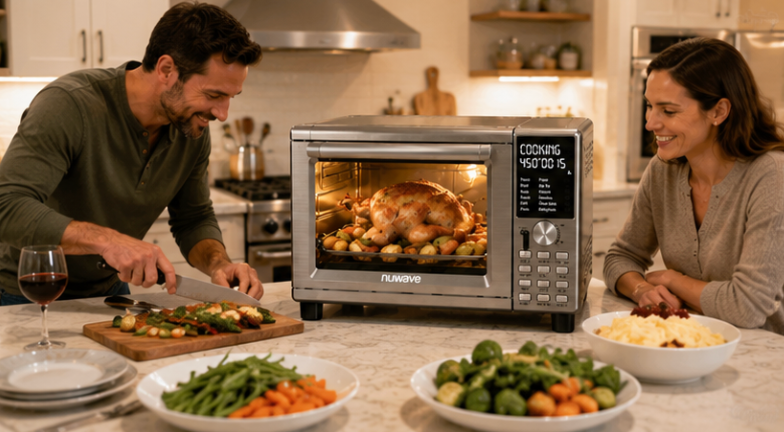
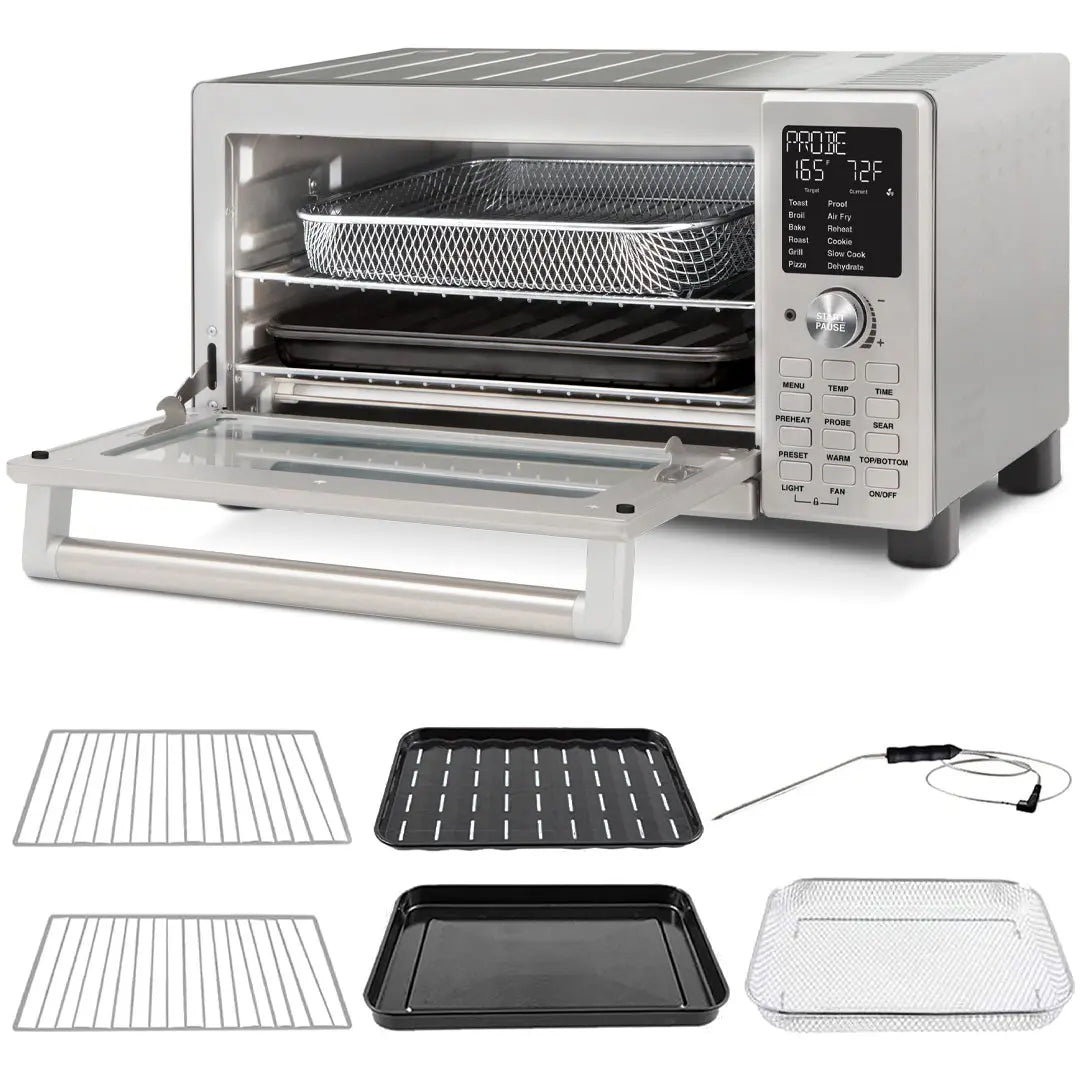
One such example is the NuWave Bravo XL, which is marketed as a 12-in-1 smart oven that combines a number of different appliances in one. The reason we describe this type of appliance as great for a space-saving kitchen is that its size is much smaller than that of a traditional oven or range. For example, the NuWave Bravo XL is 19.875" wide by 11.125” high and 14.75" deep, and is 1.0 cubic feet in capacity.
Read more on Bravo XL Pro vs Traditional Oven: Which One Fits Your Kitchen Better?
You would still need to look at purchasing a separate stovetop to install in your counter, but as there are now a significant number of different cooking tops, you may be able to find the right combination for your kitchen. Standalone stovetops are available either as electric, induction, or gas. If you do not have existing cookware and pans that would be compatible with an induction stovetop, this would incur additional costs for your new kitchen and you may wish to choose a different option instead.
How to begin your shortlist
Now that you have a better awareness of the overall market, thanks to our oven buying guide 2026, you and your family can begin to sift through the many different factors at play to make the decisions you need to get a kitchen that truly works for your family. A kitchen refurbishment is such a costly and time-consuming job that you do want to make sure you get it right, and that you aren’t left wondering what you could have done better.
The first decision to make is whether a range, a standalone oven, or a smart oven is the right choice for your kitchen. Whilst a stove or an oven usually has a capacity of 4.0 to 5.0 cubic feet, a smart oven can be more effective for your kitchen due to its multifunctionality, even though its capacity is closer to 1.0 cubic feet. Once you’ve decided on your unit type, you need to select what type of stovetop is right for your kitchen and whether electric, induction, or gas will work best in the new layout, especially considering the fuel type you want to use for both the stovetop and the oven itself.
Once you know what type of unit and fuel source suits your household best, you can shortlist several different appliances relative to your available budget and specifications. It is always recommended to read real user reviews of any device, as well as any available information from consumer reports, which often assess appliances for their capabilities to help potential customers understand the limitations and capabilities of expensive white goods.


Leave a comment
This site is protected by hCaptcha and the hCaptcha Privacy Policy and Terms of Service apply.